How to choose a side hole drilling machine for small workshops
2026-08-28
For small custom cabinet and furniture workshops, manual side hole drilling is slow, inconsistent, and creates many assembly-defective panels. A proper side hole drilling machine greatly boosts output quality while keeping labor cost down. However, many small-shop owners make two common mistakes: buying over-spec industrial models that waste budget and floor space, or picking cheap unstable units that cause frequent scrap boards.
This guide breaks down critical factors to select a suitable Side Hole Drilling Machine tailored to small-scale workshop reality.
Define your real-world production demands first
Before comparing machine models, clarify your daily output, workpiece range and fitting types.
Production volume: Low-volume custom jobs (5-15 panels per day): single-spindle CNC side hole machine works fine. Medium daily output (20-40 panels): choose dual-spindle version to cut cycle time. Skip heavy-duty six-sided drilling machines unless you run mass production; they cost far more and occupy extra floor space.
Workpiece size: Confirm your maximum panel length, width and thickness. Most small-workshop-oriented side hole machines support standard cabinet panels up to 2800 mm length, 1200-1300 mm width, panel thickness 12-50 mm.
Fitting compatibility: Make sure it supports three-in-one connector holes, wooden dowel holes, blind holes, and concealed-fitting grooves, which cover most custom cabinet requirements.
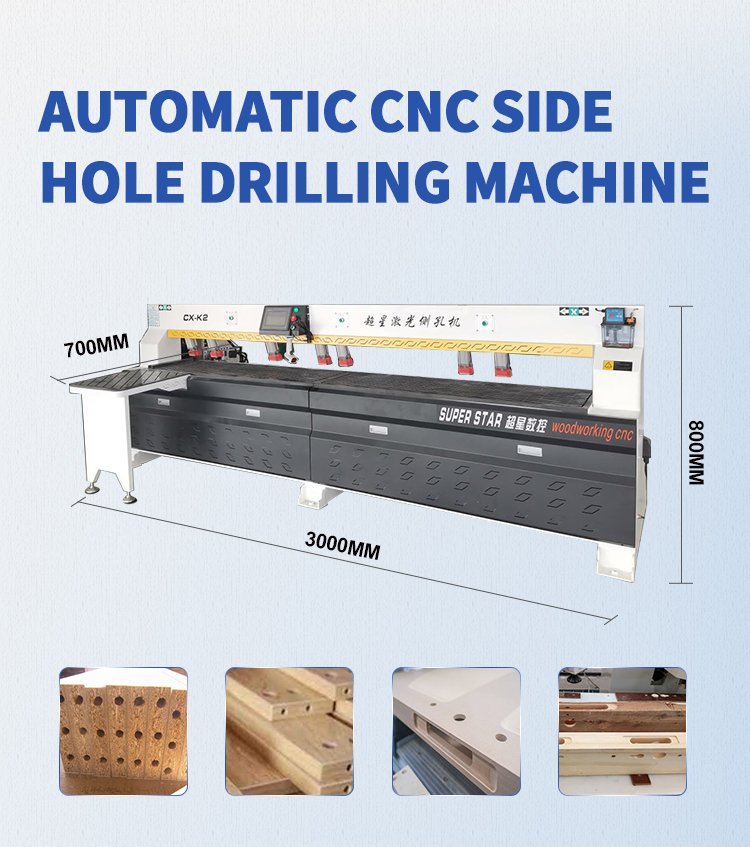
Floor space & power condition (critical for compact workshops)
Small workshops always face limited area.
Measure your available floor area, including safe loading-unloading clearance around the machine. Compact CNC side hole machines normally occupy around 3.3 × 1.3 m, do not ignore operating space when calculating layout.
Check local power supply: Most industrial side hole borers require 3-phase 380V power. If your shop only has single-phase 220V, confirm 220V compatible models in advance.
Air source: Almost all CNC side-hole machines need 0.6-0.8 MPa compressed air for pneumatic clamping. Confirm you have an air compressor ready.
Core performance & precision parameters
Precision directly decides furniture assembly effect. Bad positioning leads to misaligned holes and wasted panels.
1.Positioning solution:
Prioritize models with laser positioning or barcode-scan system. Laser-guided side hole machines are the most popular option for small shops: easy calibration, less setup time for mixed-size custom panels, no complicated programming work.
2.Spindle configuration:
Single-spindle: lower price, simple maintenance, good for low-volume custom workshops.
Dual-spindle: drill and groove at the same time, higher efficiency for growing order volume, recommended if your orders keep increasing.
Spindle power ≥1.5 kW, spindle speed 0-18000 RPM suits MDF, particle board, plywood and solid-wood panels.
3.Mechanical rigidity:
Check welded heavy-steel frame, linear square guide rails and ball screw transmission. Light-weight thin-frame machines vibrate heavily during drilling, resulting in drifting hole positions after months of usage
4.Positioning tolerance:
Target accuracy within ±0.05 mm, which guarantees smooth cabinet assembly without manual rework.
Control system & operation difficulty for non-expert operators
Most small workshops do not hire professional CNC programmers. Complex industrial controllers raise your training cost.
Select touch-screen human-machine interface, with laser scanning or barcode-scan function. Operators only need to place panels and trigger scanning; no complex G-code programming required.
Two mainstream operation modes for small shops:
Laser scanning: direct on-site measurement on panels, perfect for one-off custom-size furniture.
Barcode scanning: work together with nesting software, ideal if you already own a CNC cutting machine.
Avoid old-style button panels with complicated parameter settings; high operator error rate will slow down your production.
Budget planning, do not blindly chase lowest price
Small-workshop side hole drilling machines fall into three general ranges:
Entry-level compact CNC: cost-effective for startup custom shops, fit low-to-medium output.
Dual-spindle upgraded CNC: for growing workshops with higher daily panel quantity.
Heavy-duty six-sided drill: high investment, big footprint, mostly for large-volume factories, generally unnecessary for small workshops.
Warning: Ultra-cheap no-brand units often use thin frames, low-grade motors and unstable sensors. You will face constant calibration, high scrap-panel rate and hard-to-find spare parts. Balance price with core components quality and after-sales support.
After-sales service & spare-part availability
For overseas small workshops, after-sales support is frequently overlooked yet extremely important.
Confirm supplier provides English operation manual, remote online troubleshooting, video guidance for daily maintenance and calibration.
Verify key wearing parts (drill bits, sensors, drag-chain, pneumatic fittings) are easy to source.
Simple mechanical structure reduces daily maintenance workload, which is a big plus for small-shop teams with limited technicians.
Final selection checklist before purchase
l Matches your maximum panel dimension and thickness range
l Floor space plus loading-unloading clearance fits your workshop
l Power supply and compressed-air requirements match site condition
l Laser-positioning or barcode-scan system available
l Rigid frame + linear guide transmission, positioning accuracy ≤ ±0.05 mm
l Operator-friendly control, no advanced CNC skills required
l Supports your common fittings: 3-in-one, dowel, blind hole, concealed-connector groove
l Clear overseas after-sales support & spare-part supply
FAQ
Q: Do small workshops need a six-sided drilling machine?
A: Not in most cases. Six-sided drill delivers higher speed for mass production, yet costs much more and occupies larger space. side hole drilling machine brings better value for money for small-batch custom cabinet workshops.
Q: Laser positioning or barcode scanning, which one to pick?
A: If you mainly produce random custom-size furniture without nesting software: choose laser positioning. If you already run CNC nesting software for cutting panels: barcode scanning improves whole-line efficiency.
Q: Can side-hole machine process solid wood?
A: Yes, as long as you select correct spindle speed and suitable drill bits; dual-spindle models perform better for hardwood materials.