Linear vs. Disc ATC CNC Routers: Which Tool Changer Architecture Fits Your Shop?
2026-09-15
Automatic Tool Changer (ATC) CNC routers drastically improve woodworking efficiency by eliminating manual tool swapping. For custom cabinet shops, furniture factories and panel processing workshops, choosing the right ATC structure directly affects production speed, floor utilization, operating cost and long-term stability. The two most popular industrial configurations are Disc ATC and linear ATC. Although both realize automatic tool replacement, their mechanical design, applicable scenarios and overall performance differ greatly. This guide helps you clearly choose the most suitable tool changer for your shop scale and production type.
Disc ATC CNC Router (Rotary Tool Magazine)
The Disc (rotary) tool magazine is the most classic and cost-effective ATC solution for standard woodworking CNC machines. Tools are arranged in a circular rotating disc mounted on the spindle side.
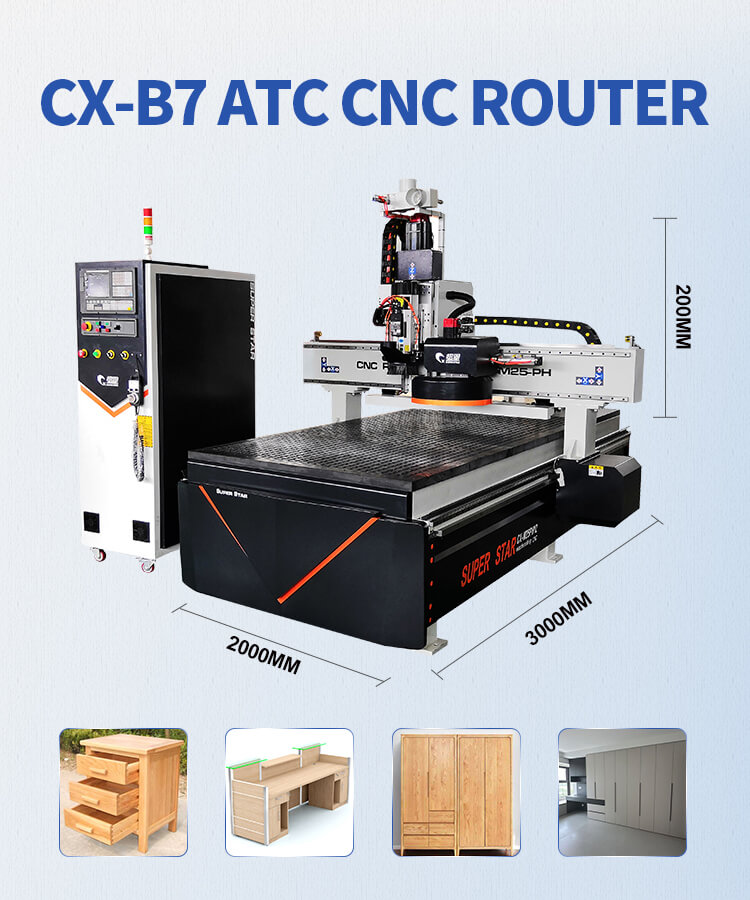
Advantages
- Space-saving design: Compact rotary structure occupies minimal floor space, ideal for small and crowded workshops.
- Cost-effective investment: Lower machine price and simpler mechanical structure reduce initial procurement budget.
- Easy operation & low maintenance: Fewer wearing parts, simple calibration, and friendly for novice operators.
Disadvantages
- Limited tool capacity: Usually 8–12 tools, insufficient for complex multi-process custom jobs.
- Slower tool change speed: Rotary indexing takes longer, reducing efficiency for frequent tool-switching tasks.
- Lower continuous working stability: Long-hour heavy cutting easily causes disc positioning deviation and wear.
Application
Small custom cabinet workshops, low-to-medium batch production, conventional nesting, grooving and hole-drilling jobs with fixed tool types.
Linear ATC CNC Router (Straight Tool Magazine)
Linear ATC places tool holders in a straight-line fixed arrangement. It is a high-end industrial-grade tool change solution designed for high-precision, high-frequency and multi-process production demands.
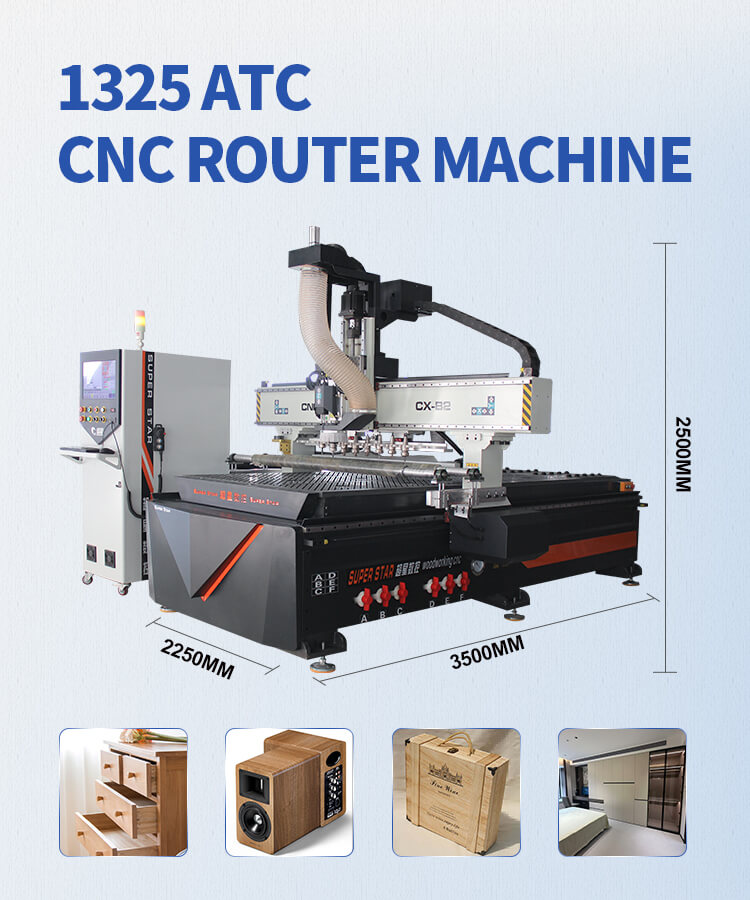
Advantages
- Large tool storage capacity: Supports 12–20+ tools, fully meeting complex furniture, 3D carving, special-shaped cutting and multi-material processing.
- Faster and more stable tool swapping: Straight-line positioning is more accurate, with shorter tool change cycle and no cumulative positioning error.
- Strong continuous production capability: Rigid structure adapts to 24-hour uninterrupted mass production with stable precision.
Disadvantages
- Larger workshop footprint: Linear tool rail requires extra installation and operating space.
- Higher cost and maintenance standards: More sophisticated transmission components require standardized daily maintenance.
Application
Medium and large furniture factories, high-end customized production, multi-style panel processing, and mass production projects requiring frequent tool switching.
Quick Shop Selection Guide
Choose Disc ATC if:
Your workshop has limited space, tight budget, mainly produces conventional cabinet panels, and requires only basic tool types for daily processing.
Choose Linear ATC if:
You need richer tool options, faster production rhythm, higher finished precision, and long-term continuous batch processing for diverse custom orders.
Conclusion
There is no absolute “better” ATC structure. Disc ATC delivers higher cost performance and space efficiency for small shops, while linear ATC provides stronger stability, higher efficiency and richer expandability for industrial-scale production. Matching the right tool changer architecture to your order type, workshop space and production scale is the key to improving output and reducing long-term operating costs.Please contact Superstar CNC for pricing and detailed information.