How to Choose an Automatic Edge Bander?
2026-08-08
Edge banding is the lifeline of panel furniture quality – it directly determines product aesthetics, durability, and competitiveness. As the custom furniture market continues to demand higher precision and efficiency, selecting the right automatic edge bander for your production needs has become a critical decision for many cabinet shops and woodworking startups. This guide walks you through process matching, core hardware, feature selection, budget planning, and the latest industry trends to help you make an informed choice in 2026.
1. Start with Your Order Mix – Avoid Over- or Under-specifying
The first step is not brand comparison but a clear understanding of your processing requirements. Different production scenarios call for very different machine configurations:
Standard cabinets, high-volume budget lines – For small startups with limited budgets and a focus on stable, no-frills output, a fully automatic EVA edge bander with mechanical adjustments, basic pre-milling, and four-head corner rounding is a cost-effective choice. However, these machines struggle with narrow panels and shaped profiles; every changeover requires manual recalibration, relying heavily on skilled operators.
Mid- to high-end custom work, slim panels – If your orders include full-height doors, narrow strips, or some shaped profiles, consider a PUR-ready automatic edge bander with servo-driven components and a narrow-panel feeding attachment. PUR adhesive offers superior water and heat resistance, finer glue lines, and much lower rework rates. The narrow-panel mechanism stabilises strips as slim as 40mm without manual assistance.
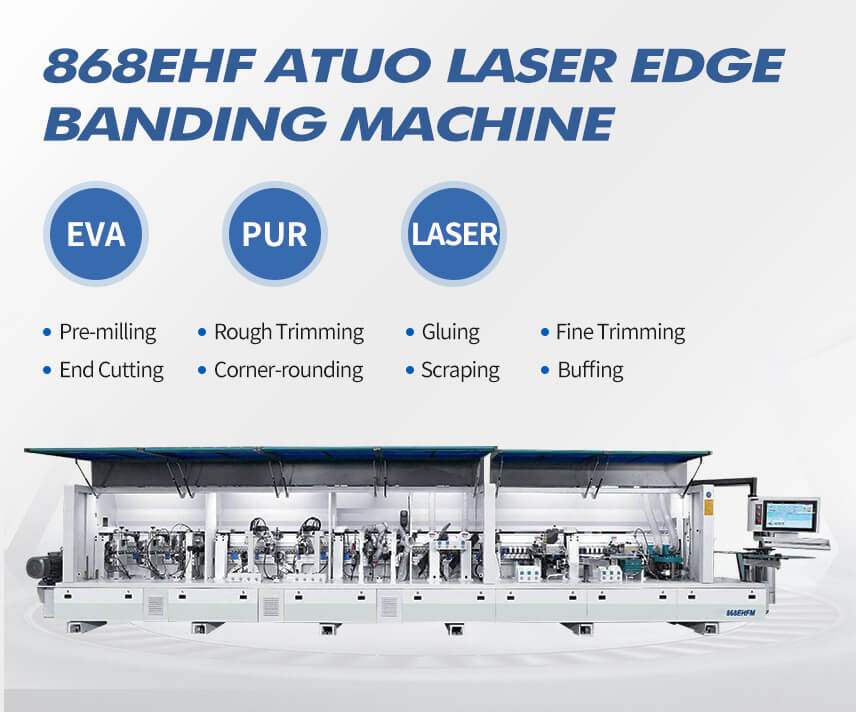
High-end custom, ultra-slim profiles, export grades – For workshops specialising in premium PET/high-gloss panels, shaped doors, or export orders that demand flawless finishing, a full-servo system with a heavy-duty welded steel frame and dual-process capability (PUR + laser) is the benchmark. Full servo control allows tooling adjustments, parameter storage, and one-click recipe recall – eliminating dependence on highly experienced operators and reducing changeover time dramatically.
2. Core Hardware – What Determines Long-Term Reliability
Beyond process needs, three hardware criteria are essential for long-term accuracy and durability:
Machine bed – A rigid, vibration-resistant frame is the foundation of precision. Quality machines use one-piece welded steel structures with stress-relief annealing, ensuring stable accuracy even during 24/7 operation. In contrast, lighter fabricated frames can deform and vibrate after a few years, leading to progressive edge-banding errors.
Drive system – mechanical vs. full servo – This is a defining feature for high-end production. Mechanical adjustment models rely on handwheels for trimming, scraping, and pressure settings – each changeover demands manual tuning and operator skill. Full-servo systems, on the other hand, motorise all key actions: tape feeding, pressing, squaring, corner rounding, and fine trimming. All parameters are entered via a touchscreen and stored as recipes. For narrow profiles and shaped parts, servo positioning ensures clean edges without chipping and uniform glue lines.
3. Essential Process Features – Match Them to Your Common Defects
Every custom shop should have the following core units: pre-milling, glue applicator, rough trimming, fine trimming, corner rounding, scraping, and buffing. Among these, pre-milling is often underrated – it uses twin rotating cutters to remove 0.5–1mm from the panel edge, eliminating imperfections from saw cuts and providing a perfectly square surface for optimal tape adhesion.
Glue application technology directly affects final quality:
EVA hot-melt – Low cost and simple to operate, suitable for particleboard and MDF in standard applications. However, it has limited heat/cold resistance and noticeable glue lines, making it unsuitable for premium finishes.
PUR (two-colour glue pot) – Water- and heat-resistant, with extremely fine glue lines and strong adhesion – three to five times more durable than EVA. Ideal for PET, soft-touch, and minimalist panels, PUR is now the mainstream choice for mid-to-high-end workshops.
Laser edge banding – Delivers zero-glue-line, seamless joints, preferred for high-gloss and PET surfaces. For those with a higher budget, a dual-process machine (PUR + laser) offers maximum flexibility.
4. 2026 Budget Tier Recommendations (Estimated USD, based on current market)
|
Budget Range (USD) |
Typical Application |
Recommended Configuration |
|
11,000 – 21,000 |
Small startups, standard cabinets |
Fully automatic mechanical EVA machine with basic corner rounding; not suited for shaped or narrow panels |
|
25,000 – 39,000 |
Mid-range custom workshops |
Servo + PUR/laser ready with narrow-panel feeding; capable of limited shaped work |
|
42,000 – 77,000 |
High-end custom / export-oriented |
Full servo system, heavy-duty steel frame, dual-process (PUR + laser) |
5. Industry Trends in 2026 – Intelligence and Precision Upgrades
The edge bander market is clearly moving towards greater intelligence and accuracy. This year, advanced machines are achieving positioning precision of ±0.03 mm – a notable improvement from ±0.05 mm in 2025 – while overall production efficiency has risen by 18–22% compared to conventional models. Adoption of flexible, intelligent edge banding solutions in the custom furniture sector is expected to exceed 60% in 2026.
Manufacturers are also focusing on process innovations, such as new automatic tool-adjustment designs for finishing units that effectively address edge-trimming defects on panel fronts – a common pain point in earlier generations. In response, many leading producers are consolidating production and standardising quality assurance across their entire product lines to ensure consistent performance and after-sales support.
Final Word: Choose for Your Actual Production Line
When purchasing an edge bander, look beyond the initial machine price. Evaluate the total cost of ownership including functional specifications, processing accuracy, and labour dependency. For workshops handling small-batch, non-standard orders, a semi-automatic bander may serve as an entry-level option. But if you face peak-season pressure, pursue high-quality system cabinets, or struggle to find skilled technicians, investing in a fully automatic machine will save you expensive hand-finishing time and reduce customer complaints from the start.
If you would like to learn more about woodworking machines, please contact Superstar CNC.