Linear Guides vs. V-Roller Drives: Which CNC Configuration Withstands Woodworking Dust Better?
2026-06-27
Introduction
Woodworking CNC equipment operates in workshops filled with sawdust and dust; the dust resistance of the drive system directly determines the equipment's failure rate, cutting precision, and service life. Most woodworking factories opt for the standard "1325" model CNC router, with the fully automatic tool-changing (ATC) version serving as the workhorse for mass furniture production.
When purchasing equipment, many first-time buyers struggle to choose between V-roller drive systems and linear guide systems. V-roller mechanisms are highly susceptible to wear from sawdust and dust, leading to frequent malfunctions in ATC CNC routers. In contrast, linear guides paired with ball screws—featuring sealed protection—offer a durable, dust-resistant drive solution ideally suited for the dusty environments of commercial CNC wood-cutting machines.
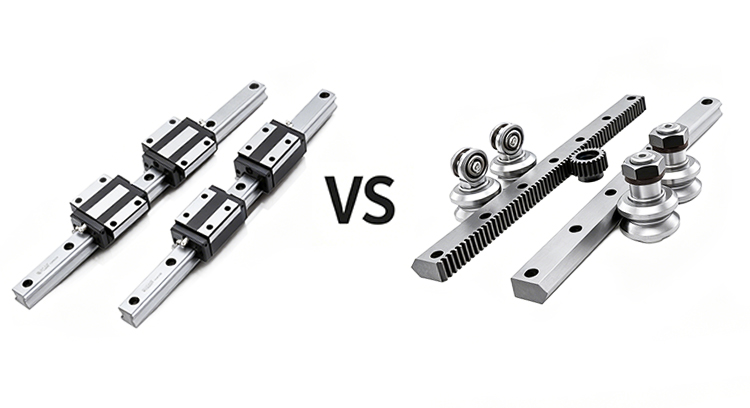
I. V-Roller Drives: Core Flaws in Dusty Woodworking Environments
V-roller systems rely on polyurethane rollers moving along V-shaped steel tracks. While low-cost and simple in design—often found in entry-level hobbyist 1325 CNC routers—they are completely unsuitable for prolonged automatic tool-changing operations in dusty environments.
1.1 Sawdust Accelerates Roller Wear
During operation, fine sawdust accumulates and becomes embedded in the V-shaped track. Under pressure, this dust acts like abrasive grit, wearing down the roller's surface in just a few months. This issue is common in budget-tier 1325 ATC CNC routers, directly resulting in jittery cutting lines and uneven engraving depths.
1.2 Inadequate Dust Protection Fails to Block Fine Particles
Standard factory-installed brush guards only block large wood chips; they cannot stop micron-sized wood dust. Dust accumulation causes jerky movement and positional drift, forcing operators to frequently disassemble the machine to clean tracks and replace rollers, which significantly disrupts production schedules.
1.3 Permanent loss of precision due to wear; non-repairable
Wear on the rollers creates operational clearance, leading to issues such as tool chatter and inconsistent engraving depths. Even with manual adjustment of the clamping mechanism, factory-level precision cannot be restored; consequently, roller-based models are unsuitable for large-scale woodworking production.
II. Precision Linear Guide Rails: Dust-proof drive systems designed for woodworking CNC
Industrial linear guide rails feature multi-layer dust-proof sealing to prevent wood chips from infiltrating internal components. They have become a standard upgrade for heavy-duty ATC woodworking CNC routers, high-spec 1325 woodworking CNC machines, and industrial-grade CNC wood cutting machines.
2.1 Triple-layer sealing protection against fine wood dust
The guide rail carriage comes standard with triple protection—a front dust scraper, an internal oil seal, and a side dust cover—to block dust from entering the ball circulation mechanism. Standard mass-produced 1325 ATC (Automatic Tool Changer) CNC routers now universally feature linear guide rail drive systems.
2.2 Stable long-term precision and superior load-bearing capacity
Linear guide rails utilize a multi-row ball bearing structure, ensuring no wobbling or deformation during panel cutting. Regular lubrication maintains machining precision at ±0.02mm, making them ideal for the 24/7 continuous operation required by 1325 ATC CNC routers.
2.3 Paired with ball screws for enhanced dust protection and stability
High-end woodworking CNC equipment consistently employs a linear guide rail and ball screw combination. Protective tubes for the ball screws prevent wood chips from wrapping around or jamming the mechanism, thereby avoiding issues like lost steps or ruined workpieces across the entire 1325 woodworking CNC router series.
2.4 Simple maintenance and minimal upkeep requirements
Operators need only clear debris from the rails and apply lubricant periodically; there is no need for frequent replacement of wear parts. This significantly reduces downtime for maintenance across various CNC wood cutting machines and 1325 automatic tool-changing CNC systems.
III. Comparison Table of Drive Systems: Linear Guide Rails vs. V-Groove Rollers
Low, dust
hardly enters
slider
Drive Type
Dust Protection Structure
Wear in Dusty Conditions
Maintenance Interval
Suitable Woodworking CNC Models
V-Groove Roller Drive
Simple brush shield, no inner seal
High, fast roller abrasion
1–3-month inspection & replacement
Entry-level cnc machine woodworking 1325 for hobby use
Precision Linear Guid
Triple dust scraper + oil seals
6–12-month routine maintenance
Commercial mass-production models (e.g., Auto 1325 ATC CNC router, multi-spindle ATC CNC router, 1325 wood carving machine)
IV. Buying Guide for 1325 ATC CNC Machines
1. Budget/DIY/Personal Use: Consider the V-groove roller 1325 CNC model. However, you must pair it with a high-power dust extraction system, clean the rails regularly, and avoid prolonged continuous operation.
2. Factory/Commercial Mass Production: Purchase ATC CNC routers or multi-spindle ATC CNC routers. Prioritize configurations featuring linear guide rails and ball screws; while the initial investment is higher, it saves costs associated with future repairs, material waste, and downtime.
3. When purchasing ATC CNC woodworking routers, prioritize models with fully enclosed guide rail covers and enhanced dust-proof sealing, as these are suitable for long-term operation in dusty workshop environments.
Conclusion
Wood dust and chips are the primary causes of wear in CNC drive systems. Due to structural limitations, V-groove roller drives are unsuitable for the long-term commercial operation of 1325 ATC CNC routers. Sealed linear guide rails paired with ball screws offer superior dust protection and operational precision, making them the ideal choice for mainstream woodworking CNC equipment.
Opting for linear guide rail drives reduces dust-related malfunctions and lowers factory operating costs, ensuring consistent quality in wood cutting and processing. If you would like to learn more about these machines, please contact Super Star CNC for a professional solution.