What are the three types of drilling machines?
2026-04-10
If you’re a woodworker—whether a hobbyist crafting custom furniture in your garage or a professional running a woodworking shop—drilling precise holes is a fundamental part of almost every project. From assembling cabinets to installing hinges, creating dowel joints, or boring holes for hardware, the right drilling machine can make the difference between a clean, professional finish and a frustrating, uneven result. But with so many options on the market, it’s easy to get overwhelmed. The good news? For most woodworking tasks, you only need to know the three core types of drilling machines. In this guide, we’ll break down each type, their key features, ideal uses, and woodworking-specific tips—so you can choose the perfect tool for your next project and achieve flawless results every time.
1. Benchtop Drill Press: The Precision Workhorse for Small to Medium Projects
The benchtop drill press is a staple in most woodworking shops, and for good reason. As the name suggests, this compact machine mounts to a workbench, saving floor space while delivering consistent, accurate drilling—something handheld drills often struggle with. Unlike handheld tools, which rely on steady hands to avoid wobbling or angled holes, the benchtop drill press features a fixed vertical spindle, a adjustable worktable, and a depth stop that lets you drill holes to an exact depth every time.
Key features of a woodworking benchtop drill press include a variable-speed motor (typically 500–3,000 RPM), a laser guide for precise alignment, and a chuck that accommodates most standard wood drill bits—from brad-point bits for clean holes in hardwoods to spade bits for larger holes. Many models also have a tilting worktable, which is perfect for drilling angled holes for joinery, such as mortise-and-tenon joints or chair legs.
Ideal uses: Benchtop drill presses excel at small to medium woodworking projects, including drilling pilot holes for screws, creating dowel holes for furniture assembly, boring holes for drawer pulls, and even sanding with a drum sander attachment. They’re perfect for hobbyists and small shops where space is limited but precision is non-negotiable. A 2024 MIT study found that drill presses (including benchtop models) improve hole accuracy by 72% compared to handheld drills—critical for fine furniture or musical instrument crafting.
Woodworking tip: For tear-out-free holes in hardwoods like maple or mahogany, pair your benchtop drill press with brad-point bits (e.g., Freud Diablo) and clamp your workpiece securely to the table to avoid movement during drilling. Adjust the speed based on wood density—slower speeds for harder woods to prevent overheating and bit damage.
2. Floor Drill Press: The Heavy-Duty Solution for Large-Scale Woodworking
If you work with large, heavy workpieces (like solid wood slabs, cabinetry, or timber frames) or need more power than a benchtop model can provide, the floor drill press is your go-to tool. This standalone machine stands on the floor, with a taller column and a larger worktable than benchtop models, making it capable of handling bigger projects and heavier materials.
Floor drill presses typically have more powerful motors (1–3 HP) and a wider speed range, allowing you to drill through thick hardwoods, plywood, and even soft metals (though they’re primarily designed for woodworking). They also feature a larger swing (the distance from the spindle to the column), which determines the maximum size of the workpiece you can drill. Most floor models come with a adjustable height worktable, a built-in dust collection system, and a more durable chuck for heavy-duty use.
Ideal uses: Floor drill presses are perfect for professional woodworkers, furniture makers, and shops that handle large-scale projects. They’re ideal for drilling deep holes in thick wood slabs, creating multiple identical holes for cabinetry, or working with heavy workpieces that would be too cumbersome for a benchtop model. Modern floor drill presses often integrate AI-driven depth sensors and self-calibrating lasers to ensure holes are drilled to 0.1 mm precision.
Woodworking tip: When working with large workpieces, use a cross-slide vise to hold the wood securely and ensure repeatable, accurate holes. Take advantage of the dust collection system to keep your workspace clean and reduce airborne particles—this not only improves safety but also helps maintain the precision of your drill bits.
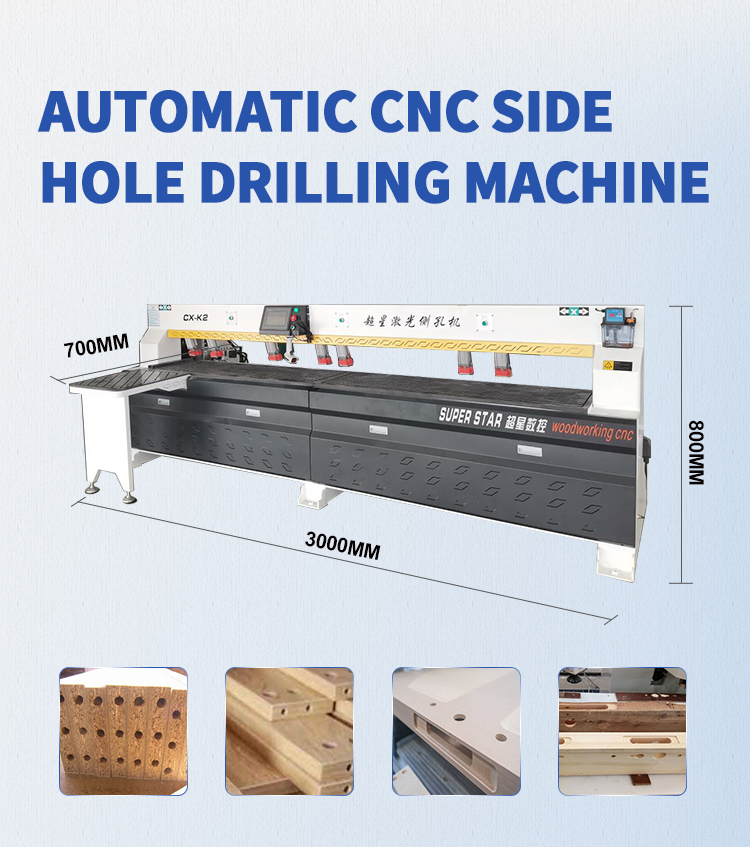
3. CNC Drilling Machine: The Automated Precision Tool for Complex, High-Volume Projects
For woodworkers who need unmatched precision, consistency, or handle high-volume production (like furniture factories or custom cabinet shops), the CNC drilling machine is a game-changer. CNC (Computer Numerical Control) drilling machines use computer programming to automate the drilling process, eliminating human error and ensuring every hole is identical—even across hundreds or thousands of workpieces.
Unlike manual drill presses, CNC drilling machines don’t require constant supervision. You simply program the hole locations, depth, and size into the machine’s computer, load your workpiece, and let the machine do the work. Many woodworking CNC drills come with multi-spindle systems, allowing you to drill multiple holes simultaneously, and automatic tool changers for seamless transitions between different bit sizes. They also integrate features like vacuum hold-downs to secure workpieces and laser guides for perfect alignment.
Key features of woodworking CNC drilling machines include digital controls, programmable patterns, high-speed drilling capabilities, and compatibility with design software (like CAD/CAM). They’re available in various sizes, from compact tabletop models for small shops to large industrial machines for mass production. Some advanced models even offer six-sided drilling, making them ideal for furniture panels and door frames.
Ideal uses: CNC drilling machines are perfect for high-volume production, complex projects (like custom cabinetry with multiple hole patterns), or any project where consistency is critical. They’re widely used in furniture manufacturing, cabinetry shops, and woodworking factories, where efficiency and precision are top priorities. They eliminate the need for manual measuring and positioning, saving time and reducing waste.
Woodworking tip: If you’re new to CNC drilling, start with simple programs and test on scrap wood before moving to your final workpiece. Invest in high-quality drill bits designed for CNC use—they’re more durable and designed to handle the high speeds of automated drilling. Regular maintenance, including cleaning the spindle and checking alignment, will ensure your CNC machine continues to deliver precise results.
How to Choose the Right Drilling Machine for Your Woodworking Needs
Now that you know the three main types of drilling machines for woodworking, how do you choose the right one? Here’s a quick checklist to help you decide:
Hobbyists/Small Shops: Go with a benchtop drill press. It’s compact, affordable, and perfect for most small to medium projects.
Professional Shops/Large Projects: Opt for a floor drill press. It offers more power and space for heavy workpieces.
High-Volume/Complex Projects: Invest in a CNC drilling machine. It saves time, ensures consistency, and handles repetitive tasks with ease.
Final Thoughts: Mastering Drilling for Better Woodworking Results
Drilling is one of the most essential skills in woodworking, and the right drilling machine can make your projects easier, faster, and more professional. Whether you’re a hobbyist just starting out or a seasoned pro running a shop, understanding the differences between benchtop drill presses, floor drill presses, and CNC drilling machines will help you choose the tool that fits your needs.
Remember: The best drilling machine for you is the one that matches your project size, volume, and precision requirements. With the right tool and a little practice, you’ll be drilling clean, accurate holes every time—no more wobbling, tear-out, or wasted materials.
If you’re ready to upgrade your woodworking tools or have questions about which drilling machine is right for your specific project, feel free to leave a comment below—Superstar CNC is always ready to help you.!